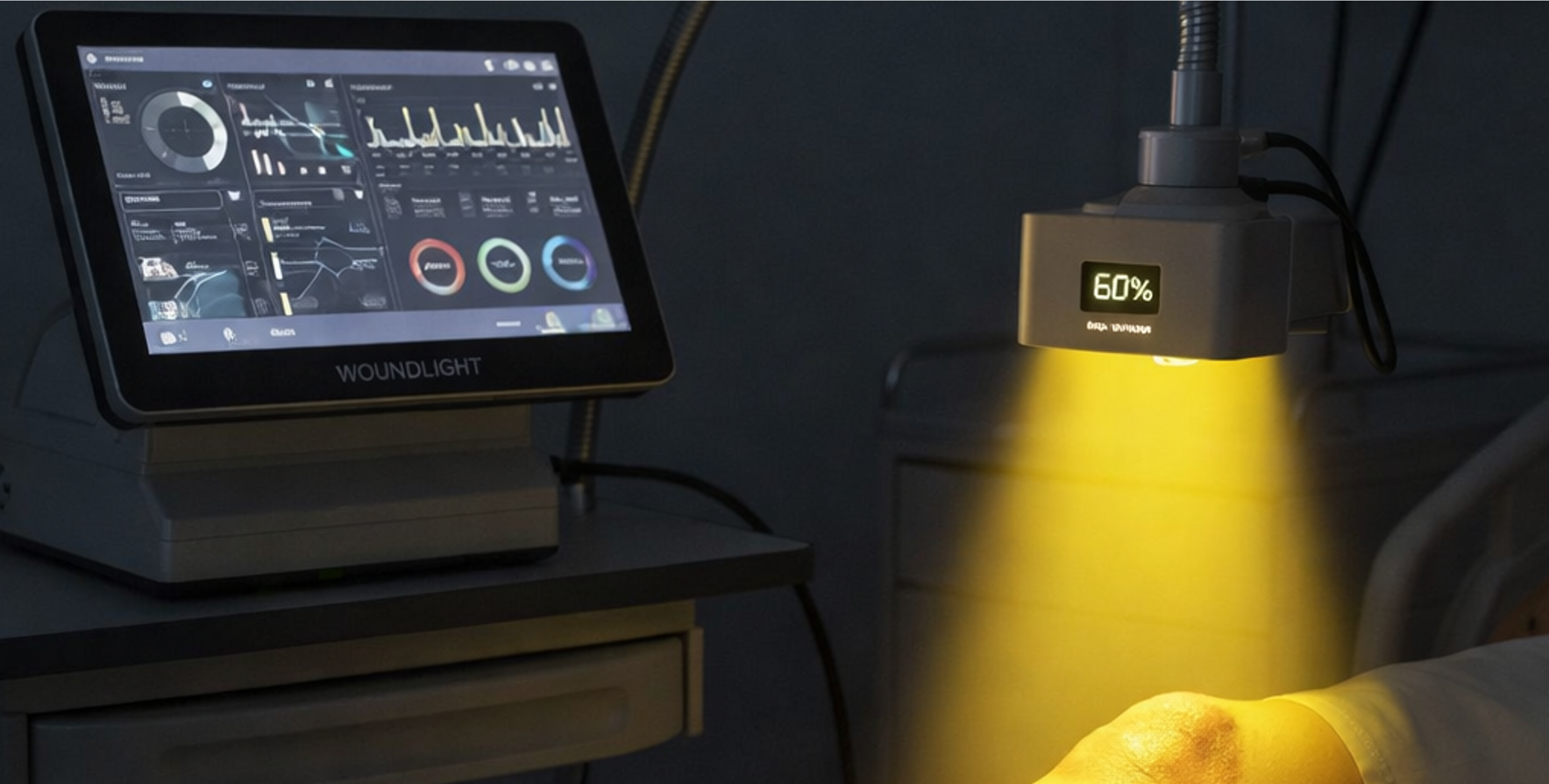
WoundLight
Unlike conventional photobiomodulation systems, WoundLight leverages patented luminescent concentrator technology to deliver specific visible wavelengths that are difficult to access with existing solutions at high optical power.

Our technology combines high optical power (>1 W), narrow spectral bandwidths (FWHM <40 nm), and precisely selected wavelengths to target specific biological mechanisms involved in wound healing. This unique combination opens new possibilities for modulating cellular responses and supporting the transition from prolonged inflammation to tissue regeneration.
Designed for clinical use, WoundLight provides fast, non-contact treatments through a lightweight, portable system suitable for both healthcare facilities and home care settings.
optical power
spectral bandwidth (FWHM)
exposure per treatment
Protocol
Device installation near the patient by the practitioner
Removal of the dressing and wound preparation
Exposure of the wound to WoundLight for 3 minutes
Application of a new dressing and continuation of the standardized care procedure
Benefits
Improve the quality of life for patients suffering from chronic wounds
Reduce prolonged hospitalizations
Make healthcare professionals’ work easier
Lower expenses for health insurance systems
Science
Wound healing is a complex biological process regulated by multiple cellular and molecular mechanisms. Through targeted light delivery, WoundLight aims to explore how specific visible wavelengths can modulate these mechanisms and support tissue repair. Our approach combines established principles of photobiomodulation with a novel spectral strategy, currently under investigation through preclinical studies.
Chronic wounds are often characterized by a prolonged inflammatory phase that disrupts the normal healing process. Persistent inflammation can contribute to extracellular matrix degradation, impaired cell migration and delayed tissue regeneration. Restoring the balance between inflammation and tissue repair is therefore a key challenge in chronic wound management.
Kuffler, D. P. (2016). Photobiomodulation in Promoting Wound Healing: A Review. Regenerative Medicine, 11(1), 107–122.Photobiomodulation (PBM) uses specific wavelengths of light to modulate cellular activity. Depending on the wavelength, irradiation parameters and biological context, light can influence cellular metabolism, proliferation, migration and inflammatory signaling. These effects are wavelength-dependent and may involve mechanisms that differ from those associated with conventional red-light photobiomodulation.
Hamblin, M.R. (2018). Mechanisms and Mitochondrial Redox Signaling in Photobiomodulation. Photochem Photobiol, 94: 199-212.WoundLight leverages luminescent concentrator technology to deliver precisely selected visible wavelengths with narrow spectral bandwidths. Our research explores whether specific spectral bands can modulate complementary biological processes involved in wound healing, including inflammatory responses and tissue regeneration.
Our working hypothesis is that combining distinct spectral bands could help create a more favorable environment for tissue repair and support the transition from the inflammatory phase to the proliferative phase.
Do you have questions about our solutions or want to learn more about Luxoderm? Our team is available to assist you.